
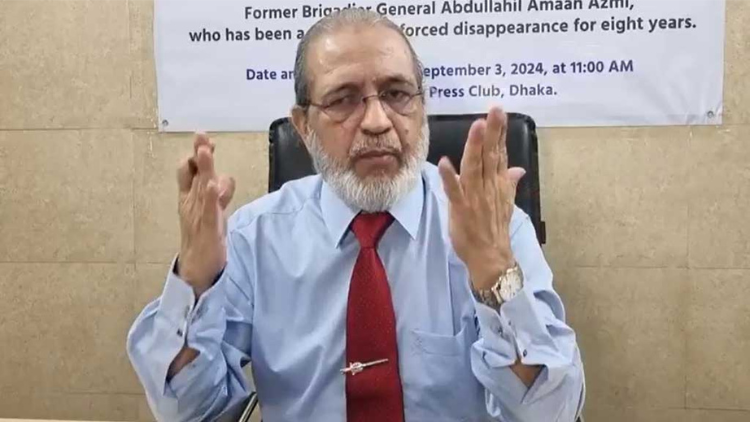
Abdullahil Amaan Azmi, recently released after an eight-year ordeal of enforced disappearance, has called for significant changes to Bangladesh’s national anthem and Constitution. Speaking via video link from a hospital in Dhaka, Azmi, the son of the former Ameer of Bangladesh Jamaat-e-Islami, Ghulam Azam, expressed his views on several critical issues during a press conference at the National Press Club.

Azmi, who was subjected to long-term detention and alleged torture due to his outspoken views against India, suggested that the current national anthem, adopted in 1971, is anachronistic and not representative of Bangladesh’s independent identity. “The anthem reflects a period of Bengal’s partition and its merger, which was a historical moment imposed by India. It does not resonate with the independent status of Bangladesh,” he stated. He proposed that a new commission be established to select a more appropriate national anthem for the country.
Regarding constitutional reforms, Azmi highlighted the need for a comprehensive review. “Our Constitution must uphold human rights and provide legal recourse for injustices, particularly concerning the armed forces,” he asserted. He criticized existing laws that he believes contravene human rights and called for their repeal, suggesting that the Constitution should reflect the values and sentiments of all Bangladeshis, irrespective of religion or ethnicity.
Azmi’s views on the Constitution also include a significant emphasis on Islamic principles. “As a Muslim-majority country, our Constitution should align with Allah’s laws. The current framework, which asserts that sovereignty rests with the people, is inconsistent with Islamic teachings, where ultimate sovereignty belongs to Allah,” he argued. He advocated for constitutional amendments to incorporate laws that reflect Muslim values.

Azmi’s comments on his captivity revealed a deep sense of injustice and personal suffering. He described his abduction as part of a broader foreign conspiracy due to his anti-India stance and detailed harsh conditions and mistreatment during his detention. “I was repeatedly questioned about my criticisms of India and endured severe torture,” he recounted. His release on August 6, 2024, came after years of uncertainty and distress, with his final moments of captivity marked by a sudden release near Tangail.
In response to questions about his father’s controversial conviction for crimes against humanity, Azmi maintained that the charges were unfounded and argued that his father’s trial was marred by inaccuracies. He stated that the Supreme Court had overturned the initial verdict and criticized the process as unjust. “Professor Ghulam Azam was one of the greatest Bengalis in history, and those who opposed him were, in my view, acting as agents of India,” he claimed.
Azmi also addressed the issue of the BDR mutiny in Pilkhana, calling for a reinvestigation into the killing of 57 army officers. He emphasized the need for recognition and honor for those involved in anti-discrimination movements and expressed a desire to contribute positively to the nation’s future.
While currently focused on his recovery, Azmi has not yet engaged in political activities but expressed a commitment to working for Bangladesh’s betterment as a patriot. His experiences and suggestions underscore a desire for substantial reform and a reflection on the nation’s foundational symbols and legal framework.