
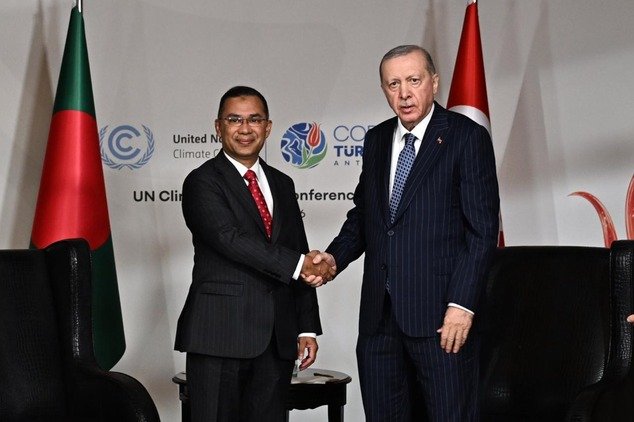
 Bangladesh and Turkey are set to deepen defence cooperation as Dhaka seeks to expand domestic military productions and diversify its arms procurement in pursuit of greater deterrence capabilities.
The proposed cooperation received particular attention during Prime Minister Tarique Rahman’s bilateral meeting with Turkish president Recep Tayyip Erdogan in Antalya on Tuesday, a day before the two-day World Leaders’ Summit of the Conference of the Parties 31.

‘Both sides expressed interest in exploring the possibility of building a defence industry in Bangladesh and of joint investment in the sector,’ state minister for foreign affairs Humaiun Kobir told reporters after the meeting at a hotel in the Turkish city.
He said the Bangladesh government had taken an initiative to establish a defence industrial park in the country.
‘Prospects of Turkish investment and joint ventures in this sector were discussed,’ he added.

The two sides were working towards signing an agreement on the issue, Humaiun added.
Prime Minister Tarique landed in Antalya on Tuesday on a three-day official visit to attend the COP31 World Leaders’ Summit.
An official aware of the development in Turkey told New Age that Dhaka and Ankara were working on arranging a bilateral visit by Tarique Rahman sometime next year in a move to bring significant progress in trade and investment, including in the defence sector between the two countries.
The proposed industrial cooperation reflects an apparent shift in Bangladesh’s defence policy as the country seeks to reduce its heavy dependence on a single arms supplier while modernising its armed forces under Forces Goal 2030.
According to the Stockholm International Peace Research Institute, China accounted for 72 per cent of Bangladesh’s major arms imports in 2019–23, while Turkey supplied 9.7 per cent, emerging as the second-largest supplier during the period.
SIPRI’s latest database, covering 2016–25, shows that China remained the dominant supplier with 66 per cent of Bangladesh’s major arms imports, followed by Russia with 12 per cent and Turkey with 7.2 per cent.
Turkey’s growing significance is also reflected in the range of military equipment it has supplied to Bangladesh. SIPRI records deliveries of 300 Cobra II armoured vehicles and six T-129B ATAK attack helicopters, with the latter delivered in 2025.
Mohammad Ashique Rahman, senior research fellow for defence studies at the Bangladesh Institute of International and Strategic Studies, said the government was focusing on developing a domestic defence industry to reduce reliance on foreign suppliers and achieve greater long-term self-sufficiency.
Earlier this month, the BNP government formed an 11-member high-powered committee led by prime minister Tarique Rahman to facilitate the development of the defence industry and promote exports of defence equipment.
In January, the interim government-led by Professor Muhammad Yunus decided to earmark 850 acres of land at Mirsarai in Chattogram for a Defence Industrial Zone to strengthen domestic military production capacity and tap into the growing global defence manufacturing market.
Ashique said Turkey’s membership of NATO and its defence-industrial links with Western countries could make it an attractive partner for Bangladesh in developing joint production capabilities.
Turkey has been aggressively expanding its defence manufacturing industry and has gained international recognition for its drone technology.
Its defence and aviation exports reached $10.05 billion in 2025, an increase of 48 per cent from the previous year, according to Anadolu Agency.
Ashique said Turkey offered Bangladesh an opportunity to develop cooperation with a country that had established a substantial defence manufacturing base.
He also pointed to Turkey’s support for the Rohingya cause as a positive factor in bilateral relations.
‘All in all, Turkey is a better choice for Bangladesh. However, as Bangladesh signs agreements, it has to be careful about the conditions. Bangladesh needs to ensure that it develops its local expertise,’ he told New Age.
Security analyst retired Air Commodore Ishfaq Ilahi Choudhury said Bangladesh needed to strengthen its defence capabilities and equip its armed forces with advanced technologies and skills as military technology progresses rapidly around the world.
‘We don’t have an enemy to fight, but we need to improve defence technologies for both deterrence and UN peacekeeping missions,’ he said.
He said developing a domestic defence industry was a welcome initiative but required careful planning, considering the high capital investment involved and the challenges of competing in the international market.
Only a limited number of countries, including the United States, China, Russia and some Western European countries have established export-oriented defence industries, he said.
‘It is good that Bangladesh is attempting to set up domestic defence industries, but authorities need to carefully design the strategy, domestic demand and export potentials,’ Ishfaq Ilahi Choudhury said.
‘Cooperation with Turkey could offer Bangladesh an opportunity not only to diversify its military procurement but also to develop local manufacturing, technical expertise and a more sustainable defence-industrial base,’ Ishfaq Ilahi said.